



Introduction: Transformation and the “Premiumization” Wave in Indian BPC Market
The Indian Beauty and Personal Care (BPC) market is undergoing a dramatic transformation. Driven by an expanding middle class and rapid urbanization, consumer values are shifting from “basic hygiene” to “science-backed efficacy.” In 2026, Indian consumers are increasingly open to high-quality brands and new experiences, with interest in Japanese and Korean products reaching an all-time high. In this context, Japanese exfoliating body towels, which combine traditional craftsmanship with advanced fiber engineering, possess significant potential as a strategic product to address the unmet needs of Indian consumers

Chapter 1: Modern Reinterpretation of Indian Bathing Culture and Rituals
In India, bathing is more than just cleaning the body; it is a ritual of spiritual purification and wellness.
1.1 Traditional “Ubtan” and Modern Challenges
For centuries, Indians have used “Ubtan”—a paste of herbs, flowers, grains, and oils. During rituals like “Abhyang Snan” (on festivals like Diwali), scrubbing the body with Ubtan after applying oil is believed to bring prosperity. While Ubtan offers exfoliation and skin brightening, it presents challenges for modern urban dwellers

Japanese towels serve as a “hassle-free ritual,” modernizing the traditional value of “polishing the body to achieve a glow.”

1.2 The “Bucket and Mug” Tradition
Many Indian households prefer the traditional “bucket and mug” bath over showers for water conservation and Ayurvedic temperature control. Japanese towels are highly compatible with this habit because their fiber structure generates rich micro-foam with minimal water and soap—a practical benefit for water-scarce regions.

Chapter 2: Gaps in Existing Bathing Accessories
The Indian market is currently dominated by unorganized SME products, leading to consumer dissatisfaction regarding quality and functionality.
2.1 Materials and Price Points of Existing Product

2.2 Unmet Consumer Needs
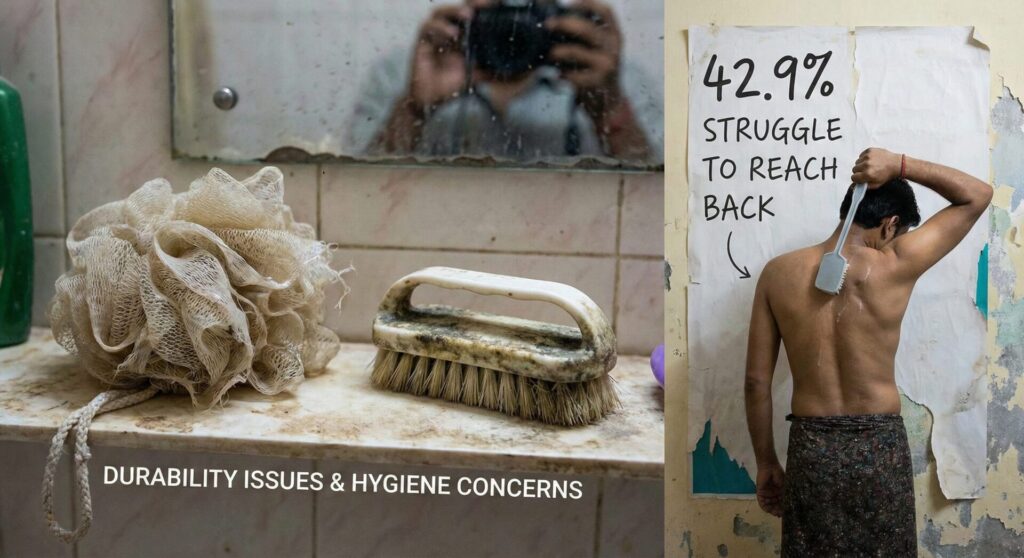
Surveys in major cities (Mumbai, Delhi, Bangalore) reveal three major pain points:
- Hard-to-reach areas: Difficulty cleaning the back.
- Lack of customized texture: Products are either “too painful” or “too soft.”
- Hygiene issues: Mold and unpleasant odors due to high humidity.
Chapter 3: The Science of “Foaming” and “Exfoliation” in Japanese Fiber Tech
The primary differentiator of Japanese towels lies in the advanced engineering of the weave and material selection.
3.1 Micro-foam Generation via “3-Layer Wave Structure”
Patented technologies (such as those by Aisen Industrial) use a triple-weave structure that incorporates air efficiently.
- Reduced Friction: Rich foam acts as a cushion, lifting dirt without irritating the skin.
- Hard Water Compatibility: Even in hard water areas (common in India), the structure mechanically forces air into the soap to maintain foam quality.
- Cost-Efficiency: Users can wash their whole body with less soap, making premium body washes last longer.

3.2 Personalized “Hardness” (5 Levels)
Indian households are often multi-generational. Japanese manufacturers provide up to five levels of hardness:
- Extra Soft: Ideal for sensitive skin, children, or dry skin.
- Standard: The most versatile type for daily exfoliation and refreshment.
- Hard: Preferred by men and athletes; thick fibers remove excess sebum and sweat effectively.
Chapter 4: Ergonomic “120cm Long Size” and Back Acne Prevention
4.1 Reaching the Entire Body
Japanese towels are typically 100cm to 120cm long, allowing anyone—even those with broad shoulders or limited flexibility—to wash their back easily using a “horizontal” or “diagonal” sawing motion.
4.2 Countering “Backne” (Back Acne)
In India’s hot and humid climate, sweat and oil buildup on the back often cause acne.
- Exfoliation: Regular removal of dead skin cells prevents clogged pores.
- Improved Circulation: The massage effect promotes healthy skin turnover.
- Hygiene: Because the towel dries quickly, there is no risk of reapplying bacteria to the skin (unlike damp loofahs)

Chapter 5: Hygiene and “Quick-Dry” Importance in Tropical Climates
5. Inhibiting Bacteria and Mold
Made from low-absorbency nylon or specialized polyester, these towels dry within hours. This prevents the “moist environment” required for bacteria and yeast to grow.
Chapter 6: Dermatological Perspective and “Anti-Pollution” Care
6.1 Physical Removal of Urban Pollutants
Major Indian cities face severe PM2.5 pollution. These fine particles stick to the skin and cause oxidative stress.
- Deep Cleansing: The precision fibers fit into skin contours to physically lift pollutants that a simple shower cannot remove.
- Barrier Protection: Unlike harsh scrubs, high-quality towels remove only unnecessary debris, preserving the skin’s natural barrier.
6.2 Enhancing Skincare Absorption
By removing the dead skin layer, these towels ensure that expensive active ingredients (like Niacinamide or Vitamin C) in body lotions are absorbed more effectively.
Chapter 7: Innovation in Plant-Based “Konjac” Towels
For eco-conscious consumers or those with ultra-sensitive skin, the Japanese Konjac (Glowomannan) towel is highly effective.
- Traditional Craftsmanship: Utilizing the 100-year-old “Shimi-Konjac” (frozen-dried) technique.
- Zero Friction: When wet, it forms a water-film gel layer that glides over the skin.
- Weak Alkalinity (pH 8.4): Naturally neutralizes and breaks down acidic fatty acids (dirt) even without soap.

Chapter 8: The “Made in Japan” Trust and Branding
In India, “Made in Japan” symbolizes quality, safety, and integrity.
- vs. “Designed in Japan”: Authentic products from specialized Japanese factories (e.g., Aisen) offer superior durability and precision compared to “Japanese-style” brands manufactured elsewhere.
- Long-term Value: They do not fray or lose functionality for over a year, making them more economical than cheap alternatives.
Chapter 9: Strategic Appeal by Target Segment
- Urban Professionals: Focus on “Backne prevention” and “Anti-pollution” to reset from city stress.
- Conscious Mothers: Focus on “Konjac safety” for children.
- Grooming-Conscious Men: Focus on “Hard texture,” “Deep cleaning,” and “Quick-dry convenience” for gym use.
Conclusion: Strategic Fit and Outlook
Japanese exfoliating towels are not just “accessories”—they are “Skincare Solutions” that solve specific Indian problems: poor reach, unhygienic tools, and urban pollution. As the Indian BPC market trends toward premiumization, the durability and dermatological benefits of authentic “Made in Japan” products will provide an overwhelming competitive edge.
Data Supplement: Technical Specifications